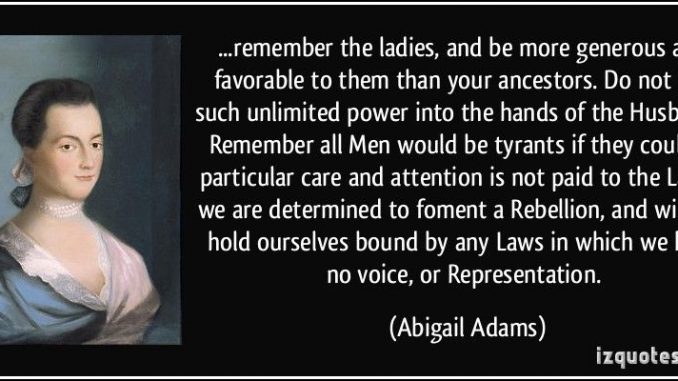

In a letter dated March 31, 1776, Abigail Adams writes to her husband, John Adams, urging him and the other members of the Continental Congress not to forget about the nation’s women when fighting for America’s independence from Great Britain.The future First Lady wrote in part, “I long to hear that you have declared an independency. And, by the way, in the new code of laws which I suppose it will be necessary for you to make, I desire you would remember the ladies and be more generous and favorable to them than your ancestors. Do not put such unlimited power into the hands of the husbands. Remember, all men would be tyrants if they could. If particular care and attention is not paid to the ladies, we are determined to foment a rebellion, and will not hold ourselves bound by any laws in which we have no voice or representation.” Widget not in any sidebars Nearly 150 years before the House of Representatives voted to pass the 19th Amendment giving women the right to vote, Adams letter was a private first step in the fight for equal rights for women. Recognized and admired as a formidable woman in her own right, the union of Abigail and John Adams persists as a model of mutual respect and affection; they have since been referred to as “America’s first power couple.” Their correspondence of over 1,000 letters written between 1762 and 1801 remains in the Massachusetts Historical Society and continues to give historians a unique perspective on domestic and political life during the revolutionary era.
Abigail bore six children, of whom five survived. Abigail and John’s eldest son, John Quincy Adams, served as the sixth president of the United States. Only two women, Abigail Adams and Barbara Bush, have been both wives and mothers of American presidents.
Future United States President John Adams arrives in Paris, France, on this day in 1778 to replace former Continental Congress member Silas Deane as a member of the American commission representing the interests of the […]
At about 5 a.m., 700 British troops, on a mission to capture Patriot leaders and seize a Patriot arsenal, march into Lexington to find 77 armed minutemen under Captain John Parker waiting for them on […]
On this day in 1776, shortly after the American victory at Boston, Massachusetts, General George Washington orders Brigadier General Nathanael Greene to take command of Long Island and set up defensive positions against a possible […]
Be the first to comment